
Dr.Acos: The Doctors of Amazon PPC Campaigns

Mirko Calamante
Head of Growth @ ZonWizard
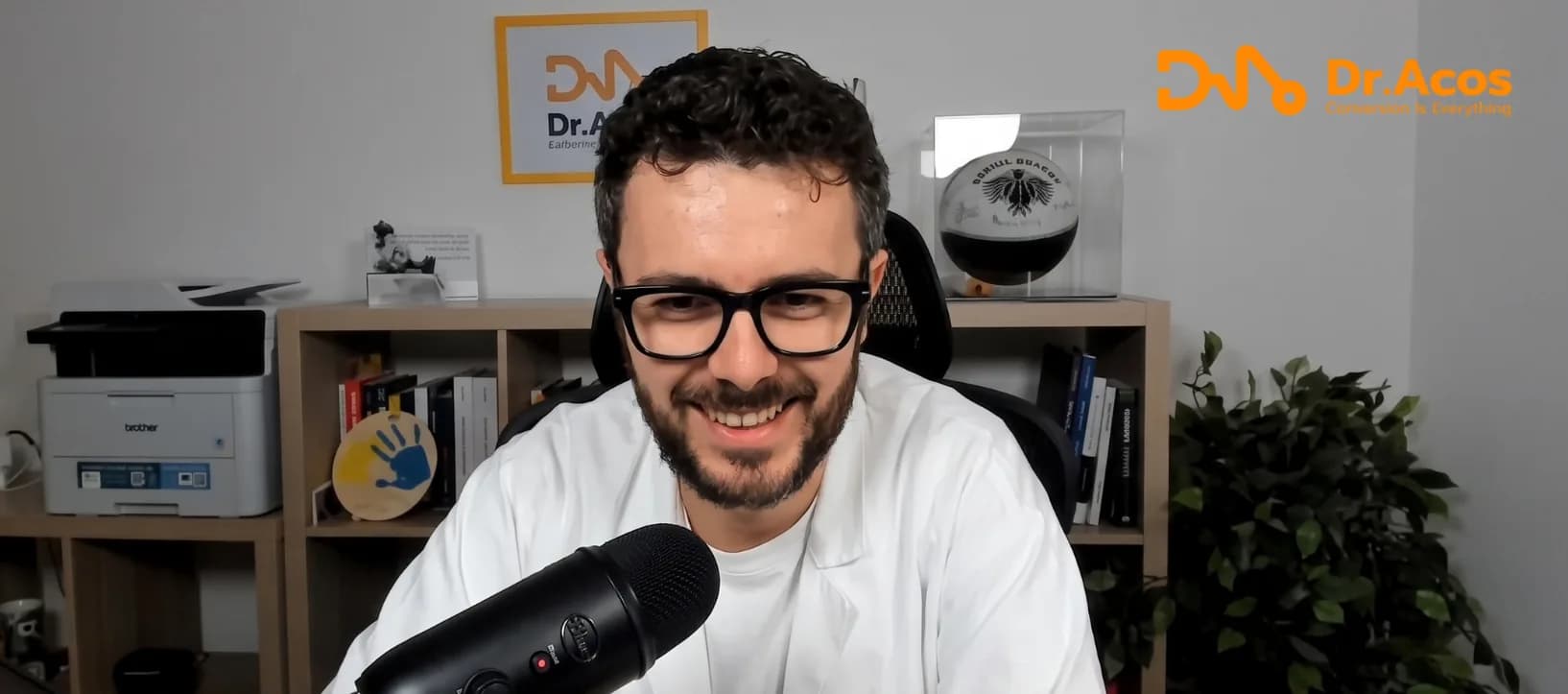
Dr.Acos manages Amazon PPC campaigns and accounts with the approach of a medical practice: daily check up, diagnosis, treatment. It is also one of the partners we have worked with the longest, because it comes out of the same group as Scuola Ecommerce, the project that brought the first Amazon selling course to Italy. We spoke with Mattia Vergerio, co-founder and head of product and quality, to hear how you go from teaching people to sell on Amazon to putting your hands into the accounts every day.
Interview with Mattia Vergerio, co-founder of Dr.Acos
How did Dr.Acos start?
Our story goes back a long way. In 2015 Vadim and I started selling on Amazon, and in less than two years we reached our first €50,000 in monthly revenue. In 2017 we met the man who would become our business partner, who had the training project in mind: that is where Scuola Ecommerce and the first Amazon selling course in Italy came from.
In 2021 Lorenzo arrived. Together we founded Empiria Services first and then Dr.Acos in 2025, which today accounts for most of our revenue.


Why move from training to running an agency?
Training lets you pass on what you know, but the hands-on part is missing. Our instinct is still the Amazon seller's: we like seeing the results, not just explaining how to get them.
So the question we had been turning over for a long time finally came up: what if we were the ones going into sellers' accounts?
Where do the lab coats come from?
There are plenty of Amazon agencies out there, so we had to specialise even further. We are specialist doctors of the advertising side, and that is where Dr.Acos came from.
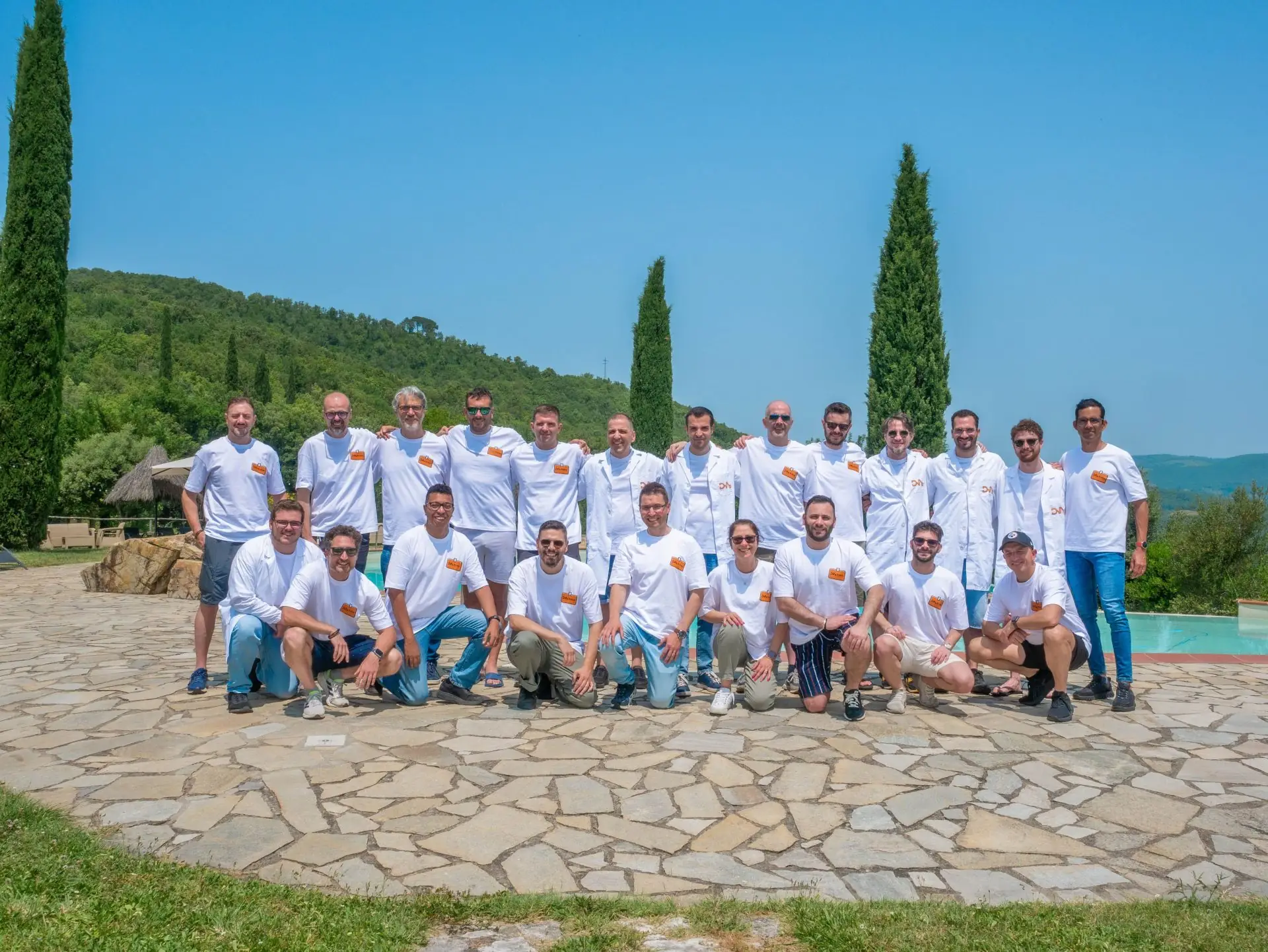
We really do wear the coat, in meetings too, and at the event a few months ago the whole team was dressed in white.
It starts as a joke, people tease you about it, but it sticks.

€14.9 million
That is the revenue generated for clients in 2025, with €1.2 million in ad spend managed. Dr.Acos has now worked with more than 250 companies and professionals, with a satisfaction rate above 90%, year on year growth of 84%, average client revenue growth of 200% and an average ACOS improvement of 38% in the first six months of management. The average ACOS across the accounts we manage sits at around 25%.
The first examination: the client's numbers
What is the first thing you do when a new client comes in?
If I do not know a business's numbers, I do not even know where to start. That is why we have a systematic rule, which is also the condition for working on results:
Has the client coming in already set up ZonWizard? Then we take access. Have they not set it up? We get it set up before we start.
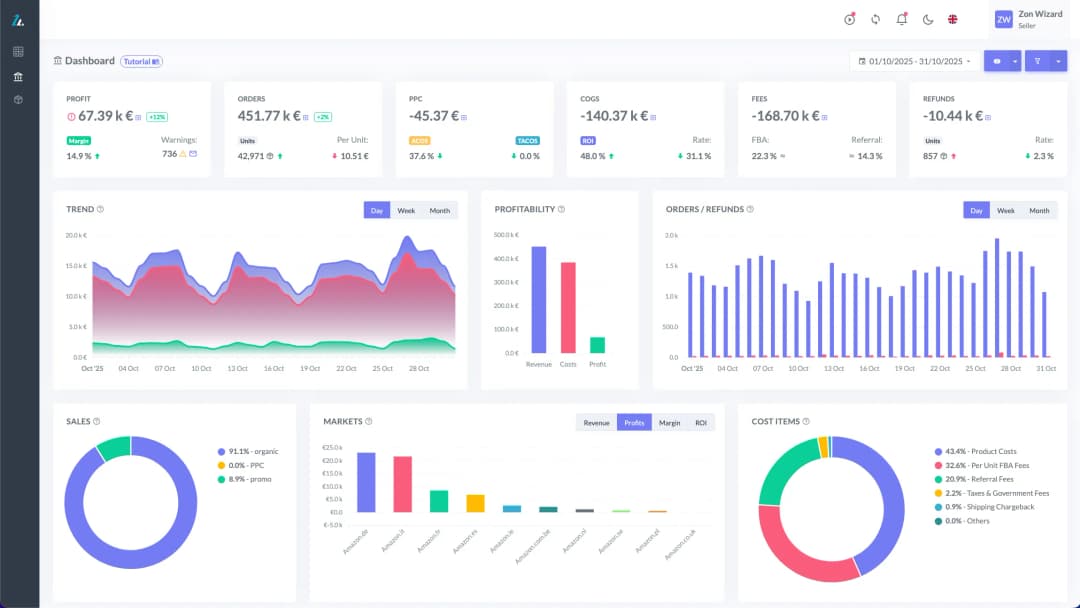
Large companies have internal management control, but those figures stay inside their own systems and we never see them. The smaller ones, at the other extreme, almost always work by feel. Either way we need common ground: ZonWizard becomes the facilitator for us and for the marketing manager, who then takes those reports to the board.
What is the mistake you see most often?
Confusing margin and markup. The client tells you: I have a 30% margin. In reality they have a 30% markup, and with a 30% markup on Amazon you go into the red immediately.
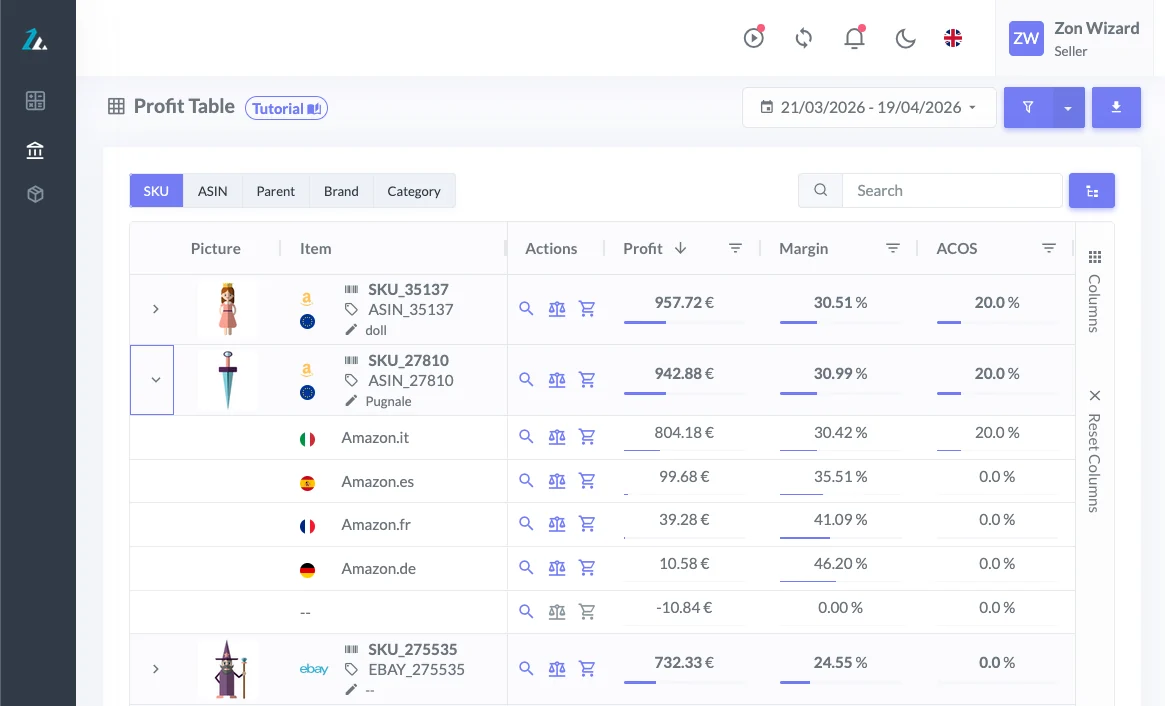
Then there are the companies that have always thought in B2B volumes: you ship a truck, you know what the truck costs, you know what production costs, and you do the maths at the end of the year. That approach does not hold on Amazon: surviving takes monthly, weekly and daily control, and that is exactly what we read in the Profit Table.
The €99.99 strategy
A client was selling a product at €99. I asked him why not €99.99: that is almost a euro more on every unit, and on an account doing 100,000 sales it is €100,000 of revenue sitting right there.
That single move generated €50,000 of extra profit at year end.
When an agency is not the answer
How do clients react when you put the real numbers in front of them?
They fall into three types. There is the one who understands and says: right, I need to raise my price and do a better job of building my brand. They know it is a growth path, and that is where we start.
There is the one who gets scared, and we show them how long it takes to improve the margin. And then there is the one who has no margin at all, and in that case we are the first to say so.
So you turn the client down?
I am going to draw criticism from a lot of agencies, but I will say it: if a project does not have the potential for at least €300,000 in revenue, it does not make sense for an agency to manage it. The agency would eat the little margin left at the end of the month.
In those cases it makes more sense to train someone internally, which is a different objective and needs saying clearly before anyone signs.
Amazon as a research and development department
Are there clients on Amazon for reasons other than revenue?
Yes, and they are the most interesting cases. We work with a large retail distribution company in the north east that does €400,000 in revenue at most on Amazon Italy, while offline that same market is worth billions.
They are perfectly happy with that, because every new product gets launched on Amazon first: they watch how it moves, they read the reviews, they see who orders product A and whether they then buy product B. That is data they would never have in traditional distribution. Then they think at European level: if the product is moving in Germany, Germany becomes one of the first markets to take it to.
They close the year with a few thousand euros of losses on Amazon, but that data is worth far more.
Sustainable growth
Is there a risk in pushing too hard?
Yes, and it applies to everyone. A lot of us came close to burnout during Covid, always in front of the computer, and someone in burnout stops performing. This is not a hundred metre sprint, it is a marathon: the peaks like Q4 are there, but they have to be absorbed.
That is why we would rather not squeeze an account to the last drop: if we close with an ACOS of 28% instead of 25% and the team is still standing, that is the right call for us.
The client can burn out too, if we sell too much. We empty their warehouse and whoever handles supply cannot keep up any more. Sustainable growth works for both sides: in the long run it is what lets you take market share and hold on to it.
And when is it worth pushing instead?
In August the opposite happened. A client wanted to put everything on holiday, pull the products and write the month off. We told him to go away with peace of mind: we would look after the products sitting in Amazon's logistics.
In that category everyone pulls their products out of FBA in August. We kept ours in, and in one week we had almost emptied the FBA inventory.
Everyone does the same things on Amazon: sometimes the move that pays is the opposite one.
Inside Dr.Acos
How are you organised?
We are around twenty people: six on advertising, eight on the catalogue, three designers, three project managers and the sales side. That lets us work in micro teams on individual accounts.
And how do you work on strategy?
We run a lot of A/B tests, and when a test works on one account we take it as a benchmark to every other account we manage. That is why each area has two internal update calls a month.
An example: I rework the images with a specific technique and conversion goes from 1.5% to 3.5%. At that point we check whether it is repeatable on the other accounts, and the same logic applies on the advertising side.
Dr.Acos and ZonWizard
What would you not give up in ZonWizard?
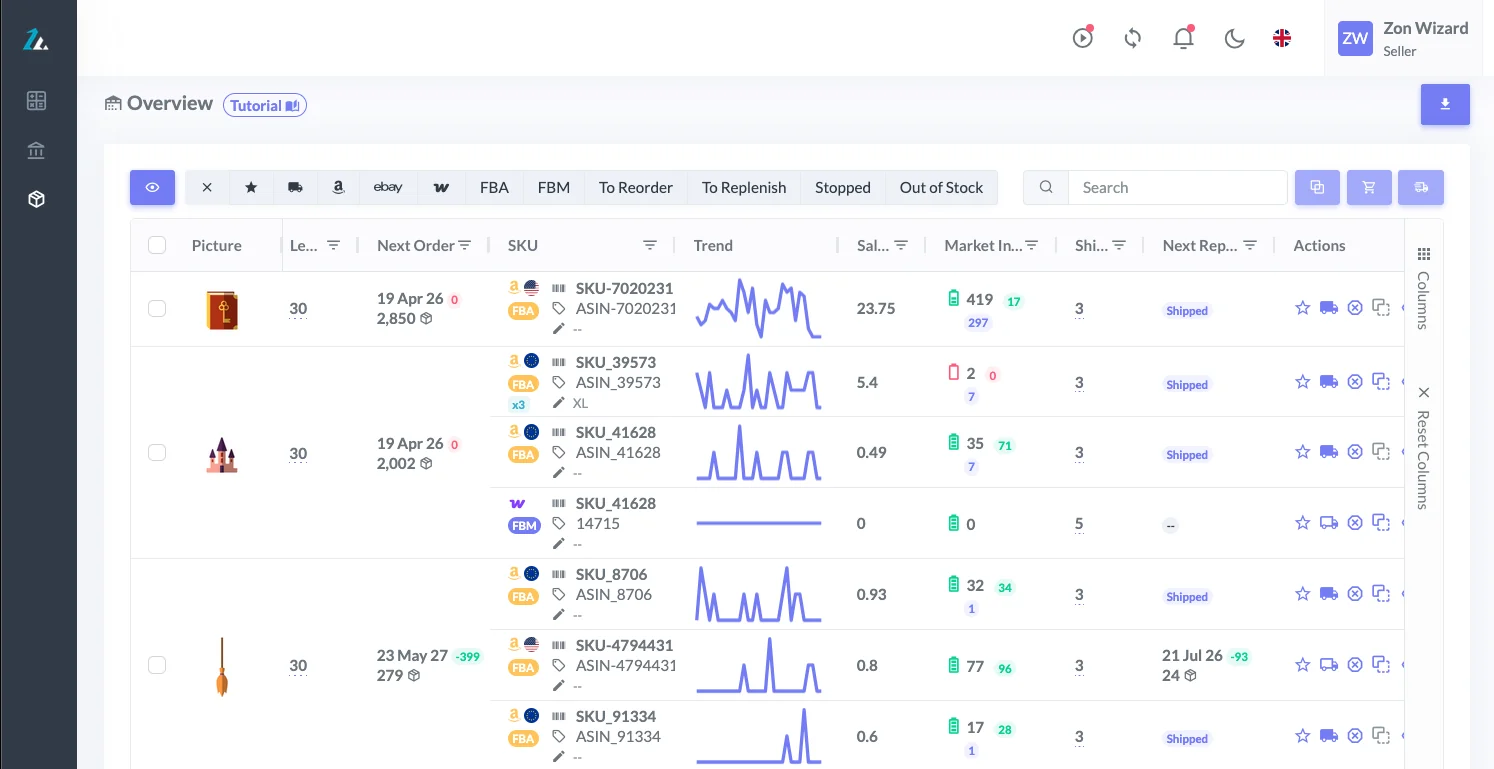
On our own small Amazon test account it is the administrative side: tax reports and the Daily Takings register filled in automatically.
As an agency, though, it is margin control. And now that you have connected the other marketplaces too, Shopify and eBay in particular, it is even more useful: on some clients we handle the e-commerce side as well, so you configure the products, connect everything, and at the end of the month the client knows what they have earned.
That is where the client can check the agency, and we can verify our own results on the client.
Because behind those accounts there are companies with twenty, thirty, fifty, two hundred people working in them, and there are real investments: a warehouse, a half million euro machine bought to do a million more on Amazon. When decisions weigh that much, the numbers cannot be approximate.
The Future of Dr.Acos
Where do you want to take the agency?
We want to consolidate as a business specialised in Amazon. If we come across small agencies that want to join a bigger project, we are open on the acquisitions front too.
Some people tell me: go abroad. But languages are not the problem, my partner lives in Hong Kong and speaks English every day, the other partner speaks four or five, and in the team we have Spanish, German and English. The point is doing well what you already do, and in Italy we can still go a lot further.
There are companies still completely outside the online world that are gems, with huge revenue and huge potential. The moment you bring them in, you have the Italian, European, American and Asian markets on Amazon.
And made in Italy?
There the numbers speak for themselves. We have an account where the revenue difference between Italy and the United States is ten times, and that is not all: the American margin is fifteen times the Italian one.
The difficulties are real, taxes, customs duties, administrative organisation, and they often do not get factored in. It is right that an entrepreneur learns on Amazon Italy first, but after that they need to look further.
Selling only in Italy today is like being the old style shopkeeper who only sold in his own square.
You can experiment starting from Germany, which is not as strong as it once was, but in the United States the numbers are enormous and the willingness to pay is higher: products that are almost commodities here sell there at twice the price.
Thank you Dr.Acos
Thank you Mattia for your time and for everything you shared.
You told the story of your progression well: from selling to training, from training to the agency. It is an interesting story not only for people who want to sell on Amazon, but for anyone with a business connected to the marketplace.
Thank you. We carry on working the way we always have: hands in the accounts, numbers under control and clients growing at the pace they can sustain.
Because in the end, behind every margin that moves there is a real company growing by its own rules.
Ready to transform your business?
Start your free 30-day trial today, setup takes just a few minutes. No credit card required, cancel anytime.